
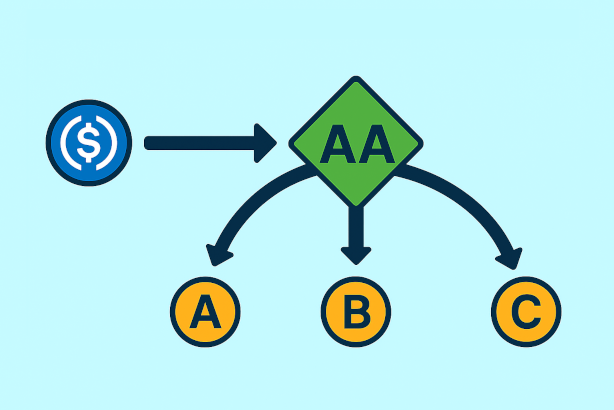
Autonomous Agents (AAs) are one of the most exciting features in the Obyte ecosystem. They make it possible to run simple or even complex decentralized applications (dApps) directly on the network – without central servers or third parties.
Best of all: AAs can be created right inside the Obyte wallet –
no special tools or technical setup required.
Table of Contents
- 🧠 What is an Autonomous Agent?
- 💡 Simple Real-World Examples
- 🔧 How Does an AA Work Under the Hood?
- 🧩 Advanced dApps with AAs
- ✅ Conclusion
🧠 What is an Autonomous Agent?
An Autonomous Agent (AA for short) is like a digital vending machine with its own address on the Obyte network. It quietly waits in the background – and springs into action as soon as someone sends it a transaction. Then it automatically executes the rule it was created with. No server, no admin, no manual steps.
You define what should happen – once – for example:
“If someone sends money → split it between these three addresses.”
The code behind it is always public, verifiable, and unchangeable.
💡 Simple Real-World Examples
Here are three easy, real-world use cases for Autonomous Agents (AAs):
1. Pocket Money
Michael has three children and doesn’t want to make three separate transfers every month.
So he sets up an AA:
If 90 USDC is receivedsend 30 USDC each to Child A, B, and C
Michael simply sends funds to the AAs address – that’s it.
The agent automatically handles the distribution.
2. Digital Savings Book
Jasmina wants to lock away 1 ETH for one year.
No access before that, no matter how tempting it gets.
She uses an AA with the following rules:
Deposits: always allowedWithdrawals: only after 2026-07-17Only Jasmina can withdraw
A digital savings book – no bank, no paperwork.
3. Community Token
Lisa has created her own token – the LISA Token – for her online project.
Instead of using a platform or handling sales manually, she sets up an AA:
If someone sends 1 USDC to the AAthey automatically receive 1 LISA Token
The AA handles everything: receives payments, sends tokens, enforces a fair price – all without middlemen. That leaves Lisa free to focus on building her community.
🔧 How Does an AA Work Under the Hood?
An AA isn’t a program in the traditional sense – it doesn’t run continuously in the background. Instead, it only reacts when it receives a transaction.
This is called trigger-based logic.
Rather than running all the time, an AA does something only when someone sends it something. At that moment, it checks:
- What was sent? (e.g., amount, token)
- Who sent it? (sender address)
- What conditions are met? (e.g. minimum amount, allowed time)
- What parameters were included? (e.g., purpose, message, extra data)
Then the AA makes a decision – exactly according to the rules it was created with.
🧮 Pseudocode: Pocket Money
Here’s how the logic behind the pocket money example might look in plain language:
If received token = USDC
→ divide the amount by 3
→ send one third to CHILD_A, CHILD_B, and CHILD_C
The actual AA code is written in Oscript and uses JSON-based structures.
But the core idea is always the same:
Check input → evaluate conditions → perform the defined action
Anyone can create their own Autonomous Agent.
All you need is your Obyte wallet – no registration, no permission required.
🧩 Advanced dApps with AAs
The examples above show simple, easy-to-understand use cases – to make AAs more tangible and explain their core idea.
But by combining multiple AAs, external data sources (oracles), and stored information within the DAG, it’s possible to build complex, interactive systems – fully decentralized.
Here are a few impressive examples from the Obyte ecosystem:
- 🔄 Oswap
A decentralized exchange (DEX) where AAs manage a shared liquidity pool.
Users can swap tokens directly – without relying on any central platform. - 🌉 Counterstake Bridge
An AA-powered protocol for secure token transfers between different blockchains. - 🏙️ Obyte City
A neighborhood game where you buy virtual land, connect with others, and unlock rewards together – all powered by AAs.
These projects show:
AAs aren’t just simple – they’re powerful.
From savings accounts to DEXs, from pocket money to cross-chain bridges – it’s all possible.
✅ Conclusion
Autonomous Agents are what make Obyte truly special.
They show how both simple and complex dApps can be built and run directly on the network – no central platform, no approval, no middlemen.
Whether it’s pocket money, token sales, or a decentralized exchange – AAs work reliably, transparently, and exactly as intended.
Why just watch when you could be part of it?
Build your own crypto mixer, a lending platform, or the decentralized crowdfunding tool Web3 has been waiting for!
Learn more:
1 thought on “Autonomous Agents”
Whether the city can be upgraded to multi-layer marketing, the links promoted by the whole network have benefits distributed, or redevelop a virtual game similar to this kind of financial management or the network-wide leadership award