
Want to trade tokens without a centralized exchange, registration, or custody risk? That’s exactly what Oswap ↗ enables. The platform runs directly on the Obyte network and is fully decentralized – no middlemen, no custodians!
In this article, we’ll take a closer look at Oswap: what it does, how it works, and the benefits it offers for you as a user.
Table of Contents
- 🔍 What is Oswap?
- ⚙️ How does Oswap work?
- 📈 How does Oswap determine the price?
- 🪙 Which tokens are supported?
- 🎯 Advantages of Oswap
- 📝 Conclusion
🔍 What is Oswap?
Oswap is a decentralized exchange (DEX) within the Obyte ecosystem.
Unlike traditional exchanges, Oswap runs entirely automated via Autonomous Agents (AAs). They handle everything: price calculation, pool logic, and liquidity management.
You simply select two tokens and swap them directly on the network:
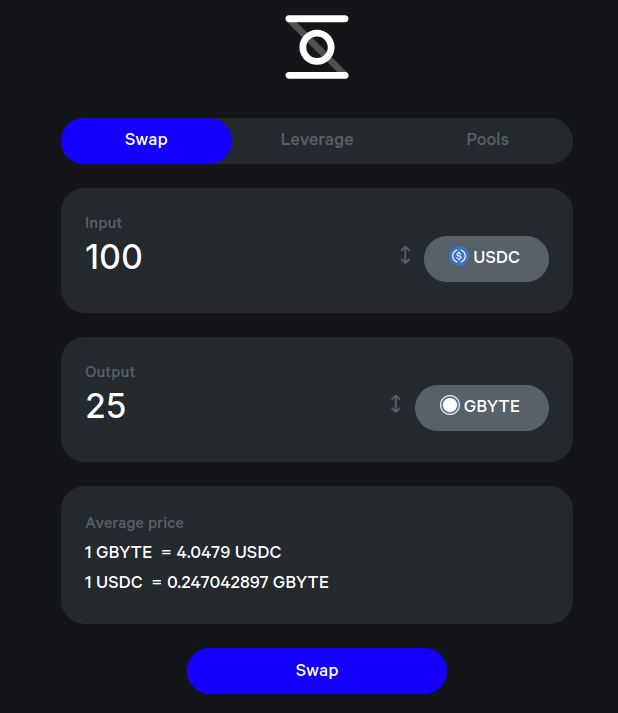
No login, no central authority –
everything runs transparently and directly through your wallet.
⚙️ How does Oswap work?
Oswap is based on an Automated Market Maker (AMM) model. This means:
There are no order books like on centralized exchanges. Instead, a so-called liquidity pool holds two tokens – for example, GBYTE and USDC.
Users trade tokens directly with the pool, while liquidity providers supply capital and earn a share of the fees in return.
Most trading pairs charge a 0.1% fee per swap.
You can find an overview of the current fees here: https://oswap.io/pools ↗
Oswap is fully governed by community voting:
Key parameters – such as the fee levels – are decided collectively through governance ↗.
Voting power lies with liquidity providers who lock their pool shares and thus actively participate in shaping the future of the platform.
📈 How does Oswap determine the price?
The price is calculated automatically based on the ratio of tokens in the pool.
Simply put:
- If you add USDC to the pool and withdraw GBYTE → the price of GBYTE increases.
- If you add GBYTE and withdraw USDC → the price of GBYTE decreases.
The swap happens instantly and is executed by Autonomous Agents (AAs).
A simplified example using the GBYTE–USDC-Pool ↗
shows how the price changes during a swap:
Current Pool State
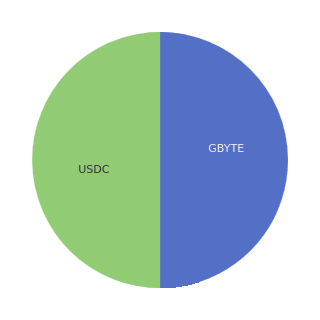
Liquidity in the pool:
1,000 GBYTE
10,000 USDC
→ 10,000 USDC / 1,000 GBYTE
= 10 USDC per GBYTE
🔁 Swap Process
Jasmina swaps 1,000 USDC for GBYTE
→ She adds 1,000 USDC to the pool
→ and withdraws approximately 95 GBYTE
New Pool State
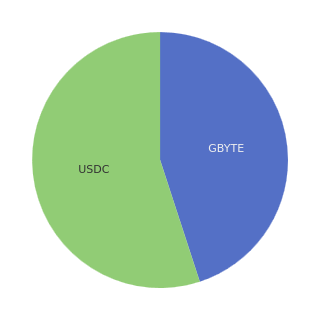
Liquidity in the pool:
905 GBYTE
11,000 USDC
→ 11,000 USDC / 905 GBYTE
= 12.15 USDC per GBYTE
This way, the price automatically adjusts to the state of the pool –
depending on the ratio between the two tokens.
💡Note:
This example is highly simplified and does not account for fees or slippage.
🪙 Which tokens are supported?
Oswap supports a wide range of tokens – from bridged assets via Counterstake to custom tokens created on Obyte.
Here’s an overview:
- ETH (Ethereum)
- WBTC (Wrapped Bitcoin)
- USDC (USD Coin)
- BNB (Binance Coin)
- KAVA, MATIC, PAXG
- OSWAP – the governance and reward token of Oswap
- CITY – the community token of Obyte City
- GBYTE – the native token of Obyte
In addition to these examples, any token on Obyte can be integrated.
As soon as a liquidity pool exists, trading is possible.
🎯 Advantages of Oswap
Oswap combines the core strengths of decentralized finance platforms:
✅ No KYC, no sign-up
✅ Direct trading from your wallet
✅ Supports all tokens on Obyte
✅ Just 0.1% fee per swap
✅ Also attractive for liquidity providers
This makes Oswap ideal for anyone who wants to trade simply, securely, and without detours – with full control over their own tokens.
📝 Conclusion
With Oswap, Obyte proves that DeFi doesn’t have to rely on complex smart contract platforms.
Thanks to its Autonomous Agent approach, Oswap makes token swapping simple, transparent, and fully verifiable.
If you’re looking for a fast and secure way to trade tokens or provide liquidity, you should give Oswap a try.
So what are you waiting for?
Install a wallet,
bridge your first tokens via Counterstake,
and make your first swap on Oswap ↗!
it doesn’t get more decentralized than this 😎
Learn more: